
Bathrooms endure more localized water exposure than almost any other room in an Ohio home. Between steamy morning showers, splashing baths, and everyday plumbing connections, water is constantly in motion just inches away from the wooden framework supporting your floor.
Every so often, a homeowner will step near the toilet base or outside the shower door and notice a faint squeak, a cracked grout line, or a tile that feels slightly spongy underfoot.
When this happens, it is easy for the imagination to run wild with catastrophic thoughts of collapsed floor joists or condemned structures.
The reality in residential remodeling is far more grounded. In the vast majority of cases, subfloor moisture issues are slow, localized situations that develop over months or years. When caught and addressed with calm, straightforward carpentry and modern plumbing techniques, restoring a bathroom subfloor is a routine procedure for experienced tradespeople.
Here is an objective, non-alarmist look at what causes moisture to reach bathroom subfloors, how to distinguish normal wear from underlying movement, and how professional remodelers evaluate floor framing safely.
1. How Moisture Reaches the Subfloor in the First Place
A bathroom floor is built like a multi-layered sandwich:
Water rarely attacks a subfloor in a dramatic flood. Instead, moisture typically migrates through one of three common, everyday pathways:
The Aging Toilet Wax Ring
Beneath every standard toilet is a compressed wax gasket sealing the porcelain horn to the drainage flange in the floor. Over years of slight toilet movement (often caused by loose floor bolts), the wax seal can break its bond. Each time the toilet is flushed, a few drops of water can seep between the porcelain base and the subfloor. Because the leak occurs underneath the fixture, it may remain completely hidden from view for a long time.
Tub and Shower Perimeter Caulking
The seam where the bottom edge of a bathtub or shower stall meets the floor tile is sealed with silicone or acrylic caulk. As houses settle through changing Midwest seasons, that caulk line can stretch, peel, or crack. Bath water dripping down the outside of the tub apron easily slips into that open seam, soaking into the substrate beneath.
Micro-Cracks in Grout Lines
Tile grout is cementitious and naturally porous unless sealed regularly. If an installer applied backer board over an uneven floor or didn’t use enough fasteners, subtle floor bounce can cause grout lines in high-traffic zones to develop hairline fractures, allowing standing puddle water to seep downward.
2. Common Visual and Physical Indicators
How can a homeowner differentiate between a superficial cosmetic flaw and genuine subfloor movement? Consider these common signs:
| Observation | Likely Nature of Issue | Recommended Trade Next Step |
|---|---|---|
| Hairline crack in grout | Often minor house settling or curing | Monitor; clean and reseal grout line |
| Rocking toilet base | Loose flange bolts or wax ring decay | Inspect wax ring & flange connection |
| Spongy floor feel | Subfloor plywood losing stiffness | Schedule non-invasive floor check |
| Persistent musty odor | Trapped moisture under substrate | Check plumbing lines & subdeck from below |
| Discolored vinyl edge | Water migrating under floor surface | Evaluate perimeter seals around tub |
1. The “Spongy” or Giving Sensation Underfoot
Solid subflooring feels unyielding when walked on. If stepping on a tile near the toilet or bathtub produces a noticeable spring, cushion, or deflection, the underlying plywood may have absorbed moisture and lost its structural density.
2. A Toilet That Rocks or Wobbles
A toilet should sit completely level and firmly anchored to the floor. If shifting your weight causes the toilet to rock side to side, the issue could simply be loose floor bolts. However, if tightening the bolts doesn’t solve it—or if the bolts pull upward freely—the wooden subfloor surrounding the closet flange may have softened.
3. Hollow-Sounding or Loose Tiles
When you walk in your socks across the bathroom floor, pay attention to the sound. Tiles securely bonded to cement backer board produce a dull, solid tap. If individual tiles produce a hollow, clacking sound or shift when stepped on, the thin-set mortar bond has broken, frequently due to moisture softening the base beneath.
4. Persistent Musty Odors That Don’t Wash Away
If a bathroom continues to smell damp or musty even after thorough scrubbing and airing out, moisture may be trapped beneath the tile or vinyl, unable to evaporate through the sealed flooring surface.
3. How Experienced Trades Evaluate Subfloors Without Guesswork
A responsible contractor will never tell you that your entire floor needs tearing out based on a casual glance from the bathroom doorway.
Instead, qualified remodelers evaluate structural conditions systematically and non-invasively:
NON-INVASIVE SUBFLOOR DIAGNOSTIC PATH
Inspection from Below (Basement or Crawlspace access)
Verification of Joist Spacing, Crown, and Moisture Levels
Localized Removal of Problem Fixture or Single Tile Row
Strategic Repair: Sistering Joists & Replacing Plywood
The Inspection from Below
In homes with an unfinished basement or accessible crawlspace, the absolute best place to evaluate a bathroom floor is from underneath:
- A contractor can shine a light directly at the underside of the bathroom subfloor and the toilet drain pipe.
- Water staining, ring marks, or past seepage patterns will be clearly visible on the raw wood sheathing without tearing up any finished tile upstairs.
- The contractor can use an electronic wood moisture meter to take objective, non-destructive moisture readings of the lumber.
Checking the Joists
The contractor will check whether the 2x8 or 2x10 floor joists themselves are sound. In the vast majority of cases, heavy dimensional lumber remains structurally intact even when the thin 3/4-inch plywood sheathing above it needs attention. If a joist has surface discoloration, the solution is often as straightforward as “sistering”—bolting a new structural joist directly alongside the existing one to restore full rigidity.
4. How Subfloor Repairs Are Handled Responsibly
If an on-site evaluation confirms that a section of subfloor has softened, the repair process is a well-established standard in remodeling carpentry:
- Containment and Removal: The toilet or affected fixtures are disconnected, and only the damaged tile and substrate are carefully cut away.
- Replacing Compromised Sheathing: Water-damaged plywood is cut back to the centerline of adjacent sound floor joists. New exterior-grade, tongue-and-groove CDX plywood or structural OSB is installed, screwed securely to the framing.
- Reinforcing Plumbing Flanges: If the toilet flange was corroded or sitting too low, a new schedule 40 PVC or cast-iron flange is installed and anchored firmly through the new subfloor.
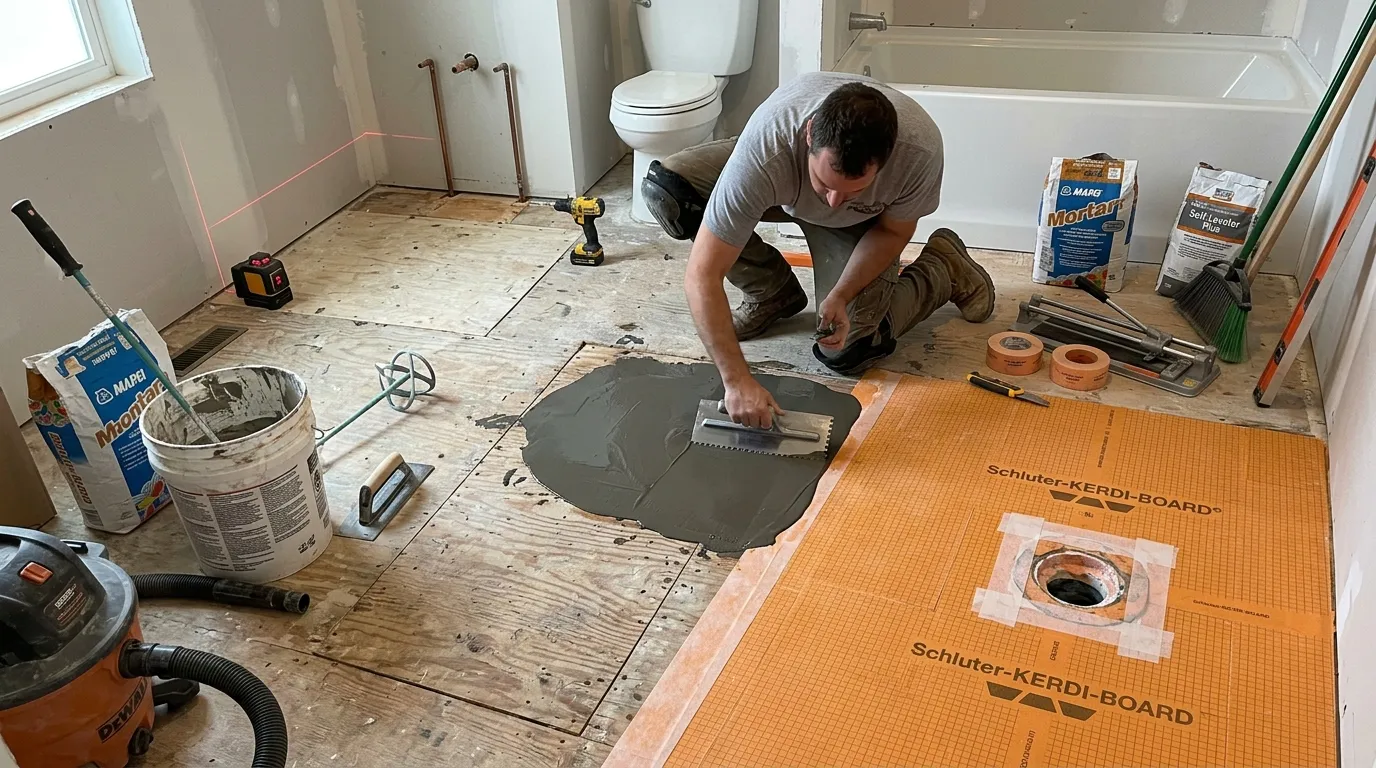
- Modern Underlayment Installation: Rather than gluing new tile directly to plywood, a proper cement backer board (or modern uncoupling membrane) is bedded in thin-set mortar and fastened with corrosion-resistant screws.
- Reinstallation and Sealing: New tile is laid, grouted, and sealed, followed by setting the toilet on a fresh wax ring and applying flexible silicone caulk around critical perimeter joints.
Frequently Asked Questions (Bathroom Subfloor Moisture)
Why do tiles frequently crack around the toilet?
The toilet is one of the heaviest concentrated points of weight in a bathroom, and users frequently shift weight when sitting down and standing up. If the subfloor underneath has softened from a slow wax ring weep, the slight flexing under that concentrated weight causes brittle grout joints and ceramic tiles to crack.
Does a soft spot mean my bathroom floor is going to collapse?
No. While a spongy feeling should be evaluated promptly, modern residential floors are constructed with heavy dimensional joists that span several feet across sturdy foundation walls. Subfloor softness usually affects only the 3/4-inch plywood sheathing in a localized zone of a few square feet. Addressing it prevents the moisture from spreading further.
Can subfloor damage be repaired without replacing the entire bathroom floor?
In many cases, yes. If the moisture is confined to the immediate area around a toilet or tub edge, a skilled remodeling specialist can often perform a localized patch, replacing only the damaged sheathing and matching nearby tiles, provided spare tiles are available or a suitable transition border can be integrated.
Moving Forward: The Reassurance of a Professional Assessment
If you have noticed a loose tile, a wobbling toilet, or a persistent damp odor in your bathroom, don’t let worry take over.
There is no substitute for an experienced, objective set of eyes. A vetted local remodeling craftsman can examine your floor from underneath, test the subfloor without destructive guesswork, and explain your options clearly and transparently. Taking care of small subfloor adjustments early keeps your bathroom solid, secure, and comfortable for years to come.
Editorial Notice & Legal Disclaimer
Important Consumer Notice: This article is published strictly for general informational, perspective, and editorial opinion purposes. It is not designed to provide structural engineering, professional mold remediation, architectural, plumbing, or legal advice, nor is it intended to educate, instruct, or influence any homeowner's repair or contracting decisions.
Bathroom floor deflection, grout cracking, and subfloor softness can stem from a variety of non-hazardous factors, including minor house settling, improper initial thin-set coverage, or seasonal humidity shifts. The observations discussed herein are general indicators and do not constitute an emergency structural hazard or definitive diagnosis. Home Services OH LLC does not inspect properties, conduct moisture tests, or perform contracting repairs. Property owners should consult directly with an independent, licensed, and insured local remodeling professional to physically inspect their floor system.
Notice a Giving Spot or Shifting Tile in Your Bathroom?
Get an objective, honest perspective without scare tactics. Connect with a trusted, independent local bathroom remodeling specialist through Home Services OH.
👉 Request an In-Person Bathroom Evaluation Through Home Services OH
We connect Ohio homeowners with experienced, independent local contractors who inspect subfloors honestly and deliver dependable, clean repairs.