
Few elements define the visual character and daily tactile experience of a kitchen quite like its cabinetry. From the smooth glide of a morning silverware drawer to the solid, reassuring close of a pantry door, kitchen cabinets are operated dozens of times every single day.
When embarking on a kitchen remodel in Ohio, homeowners encounter a wide spectrum of options. At one end sit flat-pack, mass-manufactured “stock” cabinets displayed on the shelves of big-box retail stores. At the other end lies a proud Midwestern heritage: handcrafted, solid-wood custom cabinetry, built by skilled local carpenters and master woodworkers across regions like Holmes County and North Central Ohio.
While flat-pack stock cabinets can serve temporary needs or basic rental updates, there is a profound mechanical and aesthetic difference when you step up to authentic local craftsmanship.
Here is an honest, trade-level breakdown of how custom solid-wood cabinetry compares to factory stock units, how they handle Ohio’s seasonal climate, and why thoughtful joinery makes a lasting difference.
1. Cabinet Box Construction: Plywood vs. Compressed Particle Board
The lifespan of any kitchen cabinet is determined by what you don’t immediately see: the box itself.
When cabinets are installed, they are screwed into wall studs and must permanently support heavy granite, quartz, or solid-surface countertops, plus hundreds of pounds of plates, canned goods, and cookware.
CABINET BOX ANATOMY: MATERIAL COMPARISON
1/2" Compressed particle board (MDF) Glued paper or plastic veneer exterior Fastened with plastic brackets & cams
3/4" Furniture-grade multi-ply hardwood Real wood veneer or solid wood sides Dadoed, glued, and screwed joinery
Particle Board Under Midwest Humidity
Stock and “ready-to-assemble” (RTA) cabinets are commonly built using compressed particle board or medium-density fiberboard (MDF) covered in a thin, printed vinyl film.
In Ohio, where humid summer months alternate with dry, furnace-heated winter air, particle board has a major vulnerability: moisture absorption.
- If a small leak develops beneath the kitchen sink, or if steam from a dishwasher repeatedly hits an adjacent cabinet face, particle board absorbs that moisture like a sponge.
- Once water penetrates the core fibers, particle board swells and permanently delaminates. It cannot be sanded back down or repaired; the material simply crumbles under screw tension.
The Plywood Advantage
Custom builders in Ohio construct cabinet carcasses using 3/4-inch furniture-grade hardwood plywood. Cross-laminated veneer layers make plywood exceptionally rigid, stable across seasonal humidity shifts, and remarkably resistant to moisture exposure. Screws driven into solid plywood bite into real wood grain, maintaining holding power year after year.
2. Drawer Boxes and Joinery: Dovetails vs. Staples
The drawers in your kitchen take more physical punishment than any other moving part. Every time a heavy cast-iron skillet is dropped into a deep drawer or an overfilled utensil drawer is yanked open, stress travels straight to the corner joints.
| Joinery Method | Assembly Technique | Real-World Performance |
|---|---|---|
| Butt-Joint with Glued | Shoddy staples or pin nails into MDF | Front pulls off drawer box over time |
| Staples | common in low-end mass factory units | under weight of heavy cookware |
| Dovetail Interlock | Interlocking trapezoidal wood fingers cut directly into solid maple sides | Mechanical lock holds tight even if glue experiences extreme strain |
| Mortise-and-Tenon | Milled peg-and-slot joint for frames | Resists racking and twisting |
The Art of the Dovetail Joint
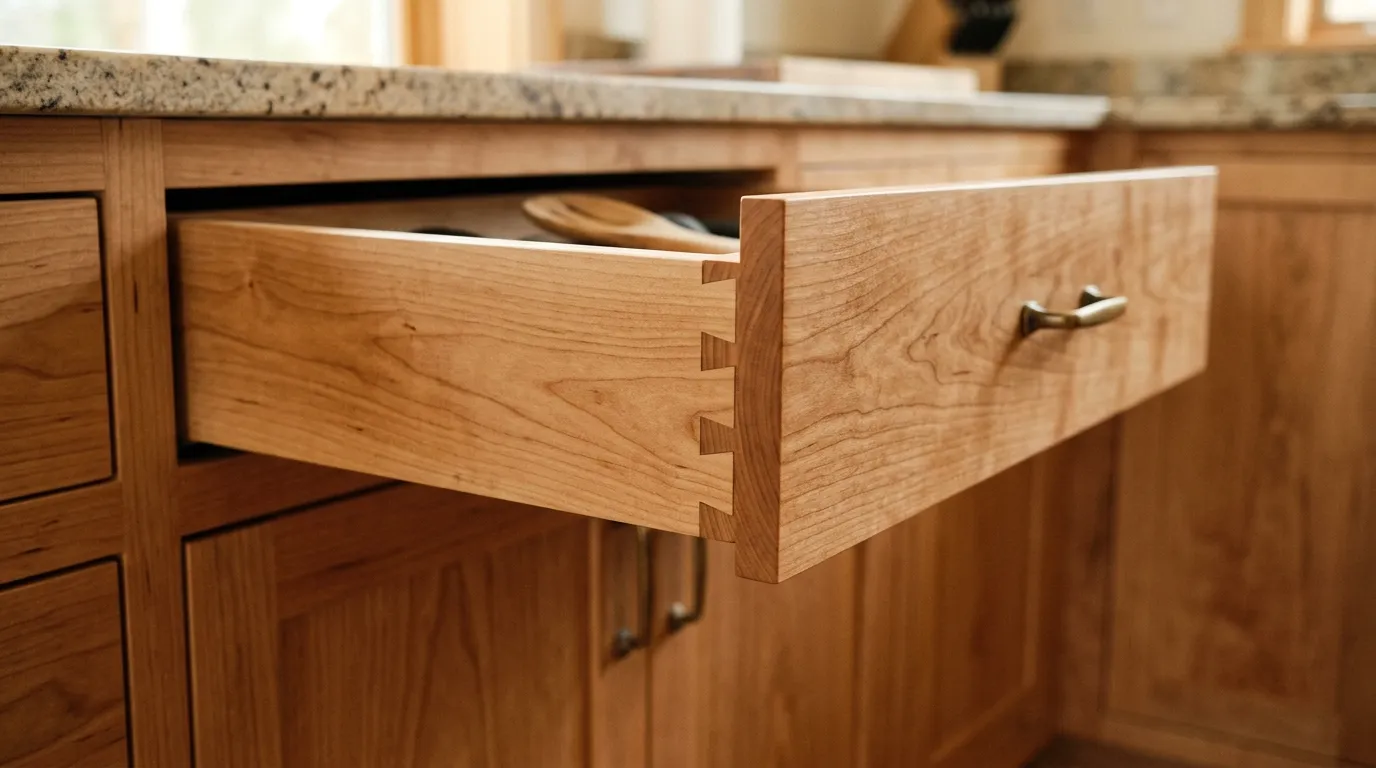
In authentic local cabinetry, drawer boxes are constructed from solid 5/8-inch or 3/4-inch hardwood (often hard maple) connected at all four corners with dovetail joinery.
A dovetail joint features interlocking trapezoidal “pins” and “tails.” Because of its physical wedge geometry, a dovetail joint cannot pull apart horizontally. Even before glue is applied, the mechanical friction of the wood fingers holds the box square. When paired with high-quality, soft-close undermount drawer glides, a dovetailed drawer box opens effortlessly under heavy loads.
Stock Drawer Assemblies
By comparison, mass-produced stock drawers often use four pieces of vinyl-wrapped MDF held together at simple 90-degree butt joints with hot glue, small metal staples, or plastic corner brackets. Over time, repeated pulling forces can pull the front drawer face clean off the box.
3. The Custom Fit: Conforming to Real Ohio Homes
One of the greatest challenges when remodeling older Midwest homes—particularly historic colonials, farmhouses, and mid-century ranches—is that no wall is perfectly straight, and no floor is completely level.
Over fifty or eighty years of seasonal settling, drywall shifts, corners pull out of square, and ceilings dip.
STOCK VS. CUSTOM ROOM DIMENSIONING
Fixed 3-inch incremental widths (12", 15", 18") Requires large blank "filler strips" to take up leftover gaps in the wall run.
Milled down to 1/16th inch to fit exact room; converts awkward corners into usable pullouts; scribes seamlessly against wavy plaster walls.
The Frustration of Stock Filler Strips
Stock cabinets are manufactured in rigid three-inch increments (e.g., 24”, 27”, 30”, 33”). If your kitchen wall measures 128 inches, a stock layout will require multiple generic wooden filler strips—essentially blank, non-functional pieces of trim—to cover the dead space between cabinets and walls.
Precision Custom Millwork
A local custom cabinetmaker measures your room down to the sixteenth of an inch.
- Cabinets are built to exact wall dimensions, maximizing every available inch of storage.
- Tall upper cabinets can be extended directly up to the ceiling, eliminating that awkward dust-collecting gap on top.
- Difficult architectural elements—such as chimney chases, uneven soffits, or awkward 45-degree corner angles—are transformed into tailored spice pull-outs, hidden step stools, or blind-corner lazy Susans.
4. Ohio's Woodworking Heritage: The Local Artisan Connection
Ohio is home to one of the largest concentrations of traditional woodworking and timber craftsmanship in North America. Regions like Holmes, Wayne, and Tuscarawas counties have nurtured generations of craftsmen who treat cabinetry as an enduring trade art rather than an assembly-line commodity.
When you work with vetted local woodworkers through an independent remodeling network:
- Local Hardwoods: Many builders select regional American hardwoods—such as black cherry, red and white oak, hard maple, and walnut—celebrating natural grain patterns rather than masking them under synthetic films.
- Hand-Applied, Multi-Step Finishes: Rather than quick spray coatings, local shops utilize multi-step hand sanding, rich stain wiping, and commercial catalytic conversion varnishes that cure into a durable, moisture-resistant protective shield.
- Supporting Local Communities: Your investment directly supports local artisans, independent millwork shops, and regional family businesses that take genuine personal pride in the pieces they create.
Frequently Asked Questions (Custom vs. Stock Cabinets)
What makes solid-wood custom cabinets more durable than stock?
Custom cabinets typically utilize 3/4-inch furniture-grade plywood boxes, solid wood face frames, and dovetailed solid maple drawer boxes, compared to stock cabinets that frequently use 1/2-inch compressed particle board and stapled joints. Plywood maintains superior screw-holding power and resists swelling from humidity and moisture far better than particle board.
What defines handcrafted Amish cabinetry in Ohio?
Ohio Amish cabinetry is renowned for its focus on authentic joinery, premium hardwood selection, and time-honored woodworking techniques. Built in small, dedicated shops across North Central Ohio, these cabinets are crafted to exact architectural dimensions, featuring solid wood doors, hand-sanded finishes, and exceptional attention to structural fit and finish.
How do custom cabinet builders maximize difficult corners?
Unlike stock cabinets that leave “dead space” or require large blank fillers, custom builders can design specialized mechanisms tailored to the exact angle of the room—such as full-extension corner pull-outs, swing-out kidney trays, custom angled pantries, or deep appliance garages that turn awkward nooks into highly functional storage.
The Value of an On-Site Kitchen Consultation
Every kitchen has its own floor plan, lighting, and architectural nuances. Deciding between stock, semi-custom, or fully handcrafted solid-wood cabinetry is not something that should be decided purely from a catalog.
An experienced local remodeling specialist will visit your home, inspect your wall plumb and floor level, discuss your family’s cooking and storage routines, and show you physical samples of door profiles, joinery types, and finish options.
Taking the time to plan your cabinetry with local craftsmanship in mind creates a kitchen that is not just functional today, but remains sturdy, elegant, and timeless for decades to come.
Editorial Notice & Legal Disclaimer
Important Consumer Notice: This article is published strictly for general informational, perspective, and editorial opinion purposes. It is not designed to provide structural engineering, architectural, legal, or product manufacturing warranties, nor is it intended to educate, instruct, or influence any homeowner's purchasing or remodeling decisions.
Wood species characteristics, moisture absorption tolerances, finishes, and wall framing conditions differ considerably across homes and manufacturers. Home Services OH LLC does not manufacture cabinetry, operate millwork shops, or guarantee specific wood durability or longevity metrics. Homeowners should consult directly with an independent, licensed, and insured local remodeling specialist or millwork professional to evaluate their specific kitchen space, inspect wood samples, and review custom fabrication options.
Ready to Explore Custom Cabinetry for Your Home?
Experience the beauty and durability of authentic, locally built kitchen cabinetry. Connect with trusted, independent local kitchen remodeling specialists through Home Services OH.
👉 Request an In-Person Kitchen Consultation Through Home Services OH
We connect Ohio homeowners with dedicated, independent local craftsmen who bring the finest Midwestern woodworking heritage into your home.