
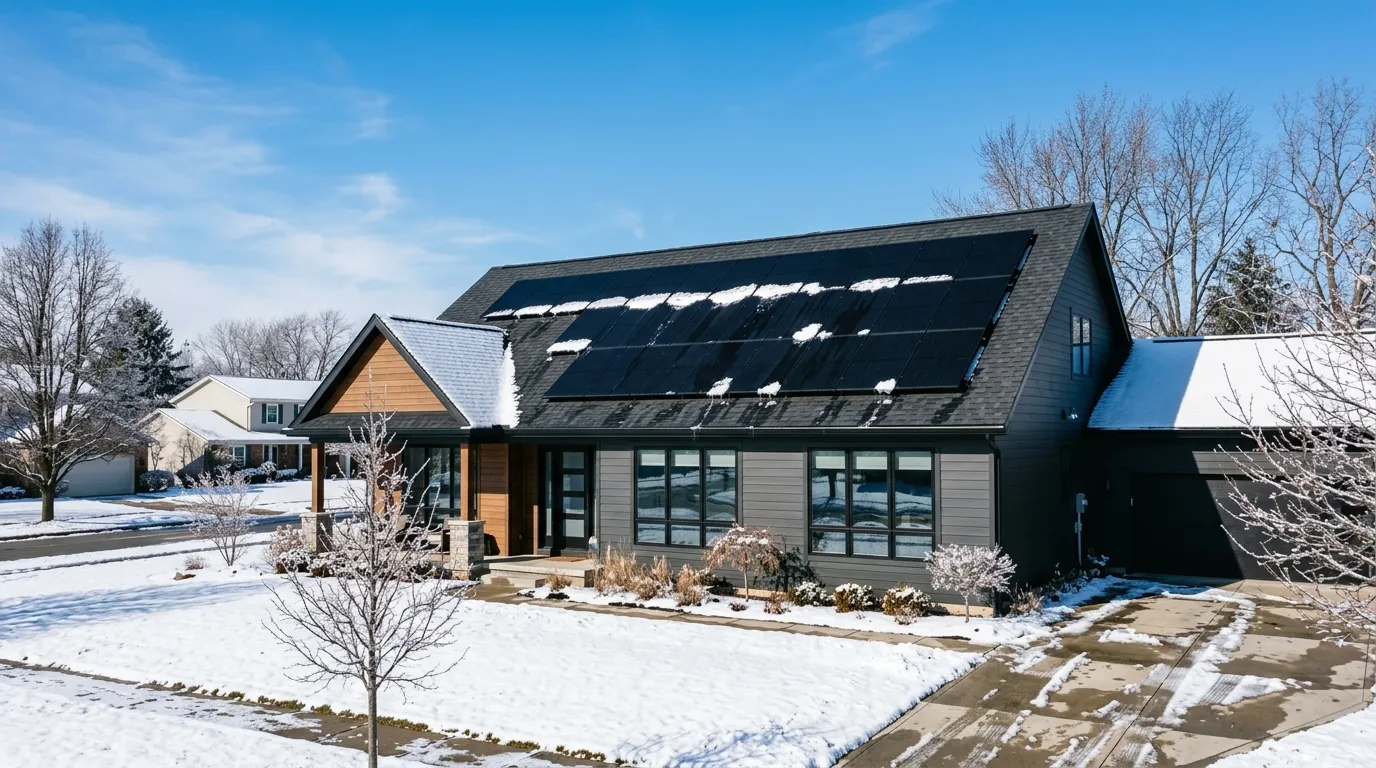
One of the most persistent questions homeowners ask across the Buckeye State is simple and understandable: “Does solar power actually make sense in Ohio, where we have months of gray winter skies and heavy snow?”
It is easy to see why skeptics wonder. We aren’t southern California or Arizona; our winters bring lake-effect cloud cover, sleet, and weeks where the sun seems to hide behind a flat blanket of Midwestern clouds.
Yet, drive through residential neighborhoods around Columbus, Mansfield, or Wayne County, and you will notice more rooftop solar arrays today than ever before.
To understand how rooftop solar functions in Ohio, you have to look past the marketing hype and examine the physical principles of how photovoltaic cells operate throughout all four distinct seasons.
Here is an objective look at how solar panels handle cold weather, overcast skies, and snow, along with how Ohio’s utility grid acts as a seasonal energy buffer.
1. Photons vs. Heat: How Solar Actually Generates Electricity
The single most common misconception about solar energy is confusing sunlight with ambient heat.
Solar panels do not operate on ambient warmth; they operate on light—specifically, electromagnetic energy delivered by photons.
PHOTOVOLTAIC GENERATION FUNDAMENTALS
Sunlight (Photons) Strike Silicon Cells | Knock Electrons Free from Silicon Atoms | Direct Current (DC) Electricity Flows Through Circuit | Inverter Converts DC Power to Household AC Electricity
When photons pass through the anti-reflective tempered glass and strike the silicon semiconductor wafer, they knock electrons free, creating an electric current. This process happens regardless of whether the outside air is 85 degrees in July or 15 degrees in January.
Overcast Skies and Diffuse Light
Even on a heavily overcast Tuesday in November, daylight still reaches the ground. While clear, direct sunlight provides the highest density of photons, modern monocrystalline solar panels are engineered to absorb diffuse ambient light that filters through cloud cover.
Production is naturally lower during dark, rainy days than on cloudless summer afternoons, but a panel exposed to daylight continues generating electricity.
2. The Cold Weather Advantage: Temperature Coefficients
Here is a scientific reality that surprises many homeowners: solar panels actually operate with greater electrical efficiency in cool weather than in extreme heat.
All electronics and semiconductors have what engineers call a temperature coefficient. As a silicon cell heats up beyond standard test conditions, its electrical resistance increases, which slightly reduces its operating voltage and efficiency.
During a crisp, sunny winter morning in Ohio:
- The clear, cold atmosphere provides crisp photon delivery.
- Low ambient temperatures keep the silicon wafers cool, allowing them to operate at peak electrical conduction.
- The panels operate with high internal efficiency, turning available sunlight into clean household power.
3. What Happens When Snow Falls on the Panels?
Snow is an inescapable part of Ohio winters. How does a rooftop solar array handle several inches of snow accumulation?
SNOW BEHAVIOR ON TILTED ARRAYS
Anti-reflective glass has virtually no friction
Typical Ohio roofs are sloped 25 to 40 degrees
Black panels absorb ambient light quickly, warming the glass surface and releasing snow.
The Natural Shedding Effect
Solar panels are manufactured with ultra-smooth, tempered glass set inside aluminum frames. Because residential panels are installed on sloped roof planes (typically pitched at 25 to 40 degrees in Ohio), gravity naturally encourages snow to slide off.
Furthermore, solar cells are dark blue or black. As soon as the snow stops and daylight returns, sunlight penetrates thin layers of snow. The dark silicon beneath absorbs solar energy and begins warming up. A microscopic layer of meltwater forms between the slippery glass and the snowpack, allowing the snow to slide off the array in sheets.
The Albedo Effect (Reflected Light)
Once snow clears from the panels but remains on the surrounding roof, yard, and neighborhood, another beneficial phenomenon occurs: the albedo effect. Clean white snow reflects sunlight back into the atmosphere like a mirror. Some of that reflected ambient light strikes the tilted panels, providing supplemental photon capture.
4. Ohio Utility Grids and Seasonal Net Metering
No discussion of Midwest solar is complete without understanding how residential systems connect to the public electrical grid.
Solar production in Ohio follows a seasonal curve:
How Net Metering Functions
Most residential solar installations across Ohio—whether serviced by AEP Ohio, FirstEnergy utilities (Ohio Edison, The Illuminating Company, Toledo Edison), or Duke Energy—are connected via net metering.
- When your solar array produces more electricity during long summer days than your household is using, that excess power flows backward through a bidirectional utility meter and into the local grid.
- Your electric utility tracks this exported energy and applies credits to your account.
- During shorter winter days when solar production is lower and home lighting or furnace blowers run longer, your home seamlessly draws standard grid power, utilizing the energy credits accumulated during sunnier months.
Because of net metering, a residential solar system is designed to balance power generation over the entire twelve-month cycle, rather than needing to produce peak power every single day of the year.
5. Critical Roof Factors That Determine Performance
While the technology works across all four seasons, solar is not an identical fit for every single rooftop in Ohio.
A responsible assessment depends on specific structural factors:
| Evaluation Factor | Ideal Consideration | Ohio Trade Reality |
|---|---|---|
| Orientation / Azimuth | South-facing roof planes | West and East planes also capture sun |
| Roof Pitch | 30 to 35-degree slope | Matches most standard Midwest gables |
| Shading Obstacles | Zero tree canopy or dormer obstruction | Mature oak/maple trees require review |
| Roof Age | Modern shingles with ample life ahead | Panels should not go on failing roofs |
- Orientation and Tilt: South-facing roof planes capture the highest concentration of daily solar exposure in the northern hemisphere, although west- and east-facing planes are also commonly used.
- Tree Canopy Shade: A dense stand of mature deciduous trees directly south of your roof will cast long winter shadows when the sun sits low on the horizon, reducing daytime exposure.
- Decking and Shingle Condition: Because a solar racking system is mounted into structural rafters to support decades of operation, the underlying roof deck and shingles must be in sound condition before installation.
Frequently Asked Questions (Ohio Residential Solar)
How do solar panels generate electricity on cloudy winter days?
Solar panels do not require direct sunlight or warm temperatures to function. They capture photons present in diffuse, ambient daylight that filters through cloud cover. While production is lower on overcast days than on sunny summer afternoons, the photovoltaic process continues generating current whenever daylight is present.
Does cold weather damage solar panels?
No. High-quality residential solar panels are rigorously tested to withstand sub-zero temperatures, freezing rain, and heavy snow loads. In fact, silicon semiconductors conduct electricity with lower internal resistance in cool temperatures, operating with high electrical efficiency when exposed to cold-weather sunlight.
How does net metering work with Ohio electric utilities?
Under Ohio net metering regulations, a bidirectional meter measures the net difference between the electricity you consume from the grid and the excess power your panels export back to the grid. Energy generated during peak summer months creates account credits that help offset electricity drawn from the utility during darker winter months.
The Value of an On-Site Solar and Roof Evaluation
Online solar calculators often rely on generic satellite imagery that cannot see low-hanging tree limbs, subtle attic framing shifts, or the remaining lifespan of your shingles.
Determining whether solar makes practical sense for your specific property requires an in-person assessment by an experienced local professional.
A qualified specialist will:
- Measure your roof planes and map real-world shading throughout the day.
- Inspect your electrical service panel to confirm amperage capacity for grid interconnection.
- Examine the age and structural framing of your roof decking to ensure it can support an array securely.
Taking a measured, objective look at your roof’s actual solar potential ensures you make informed decisions based on facts, not high-pressure sales pitches.
Editorial Notice & Legal Disclaimer
Important Consumer Notice: This article is published strictly for general informational, perspective, and editorial opinion purposes. It is not designed to provide electrical engineering, utility regulatory, tax, financial, or architectural advice, nor is it intended to educate, instruct, or influence any homeowner's energy purchasing or contracting decisions.
Photovoltaic production varies substantially based on roof orientation, pitch, tree shading, local utility tariff structures, inverter efficiency, and seasonal weather patterns. Home Services OH LLC does not manufacture panels, provide grid interconnection services, guarantee specific electric bill offsets or kilowatt-hour yields, or quote utility buyback rates. Property owners should consult directly with an independent, licensed, and insured local solar installer and review current tariff rules with their regional electric utility provider.
Curious About Your Roof’s Solar Potential?
Explore your property’s layout with an honest, objective evaluation from a verified local specialist. Connect through Home Services OH.
👉 Request an In-Person Solar & Roof Assessment
We connect Ohio homeowners with experienced, independent local specialists who evaluate solar feasibility honestly and transparently.