
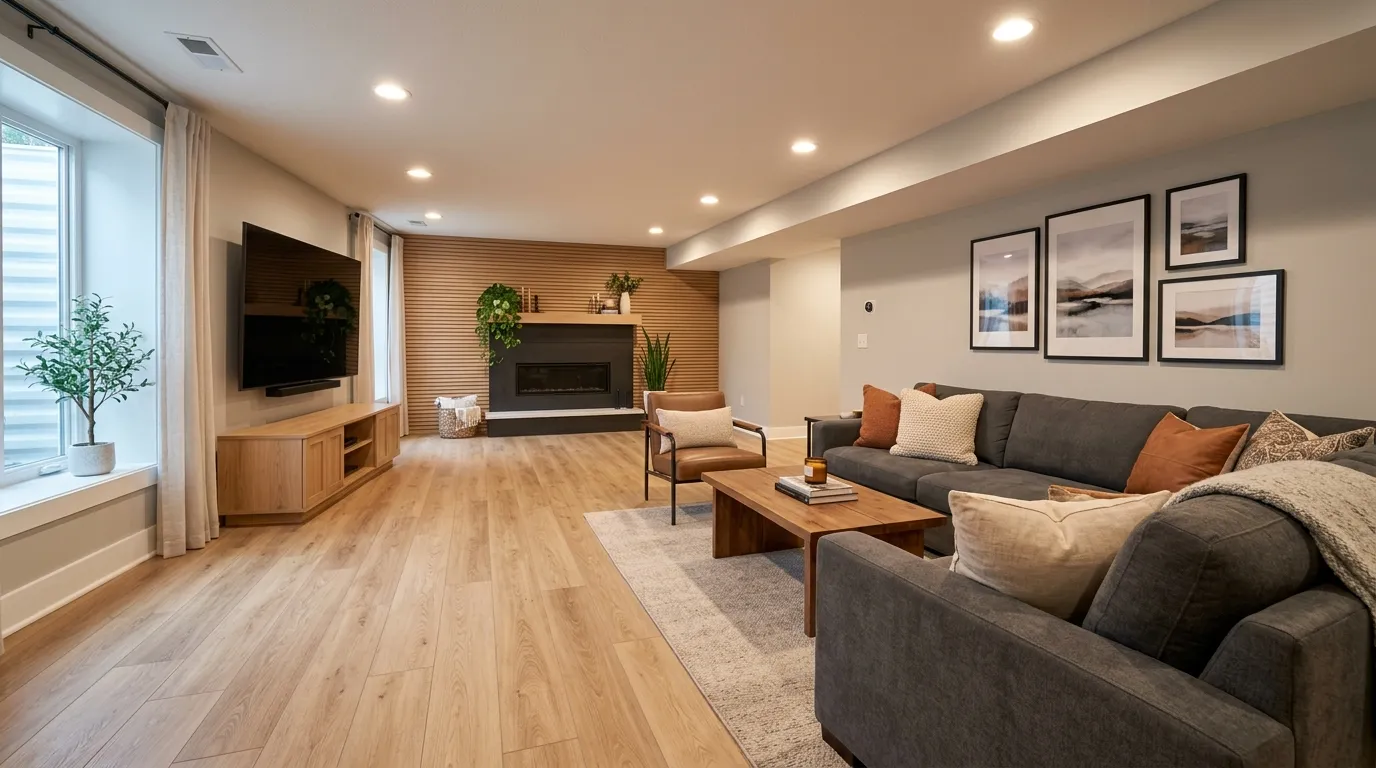
Across Ohio, finished basements represent some of the most valuable, versatile square footage in the home. Whether transformed into a family recreation room in Columbus, a cozy home theater in Akron, or a children’s playroom in Mansfield, lower levels offer an ideal retreat.
However, designing a finished basement in the Midwest comes with one unique structural reality: the concrete slab is below grade.
Unlike above-ground living rooms resting on framed wooden floor joists, a basement floor sits directly against the damp earth. Throughout Ohio’s humid summers and cold winter months, concrete acts like a dense, porous sponge, constantly absorbing and transmitting microscopic water vapor upward.
When selecting flooring for a basement, conventional solid hardwood is widely avoided because natural timber planks cup, warp, and buckle when exposed to concrete moisture.
That leaves homeowners with two premier modern contenders: Stone Plastic Composite Luxury Vinyl Plank (SPC LVP) and Engineered Hardwood.
Here is an objective, trade-level breakdown of how both materials perform over below-grade concrete slabs, how they handle seasonal humidity, and what surface preparation is essential for a lasting installation.
1. Below-Grade Concrete: The Invisible Moisture Vapor Challenge
Before evaluating flooring products, it helps to understand why below-grade basements behave so differently from upper floors.
Even when a concrete floor looks and feels bone-dry to the touch, it is rarely static:
BASEMENT MOISTURE TRANSMISSION PATH
Surrounding Ohio Soil (Rainfall & High Water Table) | Porous Concrete Slab (Absorbs Capillary Groundwater) | Moisture Vapor Emissions (Migrates Upward Toward Lower Humidity) | Flooring Underlayment / Plank Core (Must Resist or Block Vapor)
Capillary Action in Concrete
Concrete is full of microscopic capillaries. Water vapor from surrounding soil naturally migrates through the slab toward the conditioned, lower-humidity air inside your home. If you lay an impermeable, non-breathable wood product directly over raw concrete without proper testing or vapor retarders, that trapped moisture collects beneath the planks, softening glues and compromising wood layers.
2. Luxury Vinyl Plank (LVP): The 100% Waterproof Rigid Core
Modern Luxury Vinyl Plank has evolved far beyond the flexible sheet vinyl or peel-and-stick tiles of the past. The premier choice for below-grade applications is Stone Plastic Composite (SPC) rigid core vinyl.
ANATOMY OF SPC RIGID CORE VINYL
Clear polyurethane embossed with realistic grain
High-definition photographic visual layer
Limestone powder composite bonded with polymers
Integrated IXPE or acoustic cork backing
The Limestone Core Advantage
SPC flooring is made by blending crushed limestone mineral powder with synthetic polymers under intense heat and pressure. The resulting core is dense, rigid, and completely impervious to water.
- If a basement dehumidifier overflows, or if minor plumbing seepage occurs, SPC planks will not swell, soften, or delaminate.
- The rigid core helps mask minor subfloor imperfections, resisting the “telegraphing” effect where bumps in concrete show through flexible vinyl.
Everyday Family & Pet Durability
LVP is protected by a transparent top wear layer, typically measured in mils (thousandths of an inch). A commercial-grade 20-mil wear layer provides robust resistance against dog claws, heavy dropped toys, dragged furniture, and snowy boots.
3. Engineered Hardwood: Authentic Wood Character with Engineered Stability
For homeowners who place a premium on natural architectural warmth and the authentic feel of real wood underfoot, engineered hardwood remains a compelling contender.
Unlike solid timber milled from a single tree trunk, engineered hardwood is constructed in cross-laminated layers:
ANATOMY OF ENGINEERED HARDWOOD
Genuine hardwood veneer (Oak, Maple, Walnut, etc.)
Multi-ply structural birch or eucalyptus plywood
Balanced hardwood backing for dimensional tension
Dimensional Stability Across Changing Seasons
Because the underlying plywood veneers are stacked with alternating grain directions (at 90-degree angles to one another), each layer counteracts the natural expansion and contraction of the adjacent layer.
- Engineered hardwood handles moderate seasonal humidity shifts far better than solid planking.
- It delivers the unmistakable visual depth, unique grain swirls, and acoustic warmth of real wood.
Moisture Limits in Basements
While engineered hardwood is significantly more stable than solid lumber, it is still real wood. It cannot tolerate standing puddles, severe slab vapor emissions, or plumbing backups. When installed in basements, it requires:
- An electronic concrete moisture test to verify low emission rates.
- A heavy-duty, certified 6-mil vapor barrier membrane rolled across the concrete.
- Strict maintenance of indoor relative humidity between 35% and 55% year-round using a dependable basement dehumidifier.
Direct Material Comparison
How do these two popular options stack up across common basement criteria?
| Evaluation Factor | Stone Plastic Composite (SPC LVP) | Engineered Hardwood Flooring |
|---|---|---|
| Water Resistance | 100% waterproof; unaffected by moisture immersion | Moisture-resistant; vulnerable to prolonged standing water |
| Core Composition | Crushed limestone and polymeric resin | Cross-laminated structural multi-ply plywood |
| Surface Authenticity | High-definition photorealistic print film with texture | Genuine natural hardwood veneer (Oak, Hickory, etc.) |
| Pet & Scratch Defense | Exceptional defense against active pet claws | Moderate; real wood finishes can scratch over time |
| Slab Moisture Tolerance | Very high tolerance when paired with vapor barrier | Requires verified low concrete moisture emissions |
| Acoustic & Warmth Feel | Moderate; benefits from premium acoustic underlay | Naturally warmer and softer underfoot than vinyl |
| Repair & Refinishing | Damaged planks must be unclicked and replaced | Thicker wear layers may be lightly screened and recoated |
4. The Critical Foundation: Subfloor Leveling
Regardless of whether you choose luxury vinyl or engineered hardwood, the success of your basement floor depends almost entirely on what happens before the first box of flooring is opened.
Floating click-lock floor systems require a flat subfloor to function properly:
SUBFLOOR PREP TRADE STANDARD
No more than 3/16" variation over a 10-foot span.
Basement slabs in Ohio frequently feature high spots near foundation walls and low dips around floor drains and sump pits.
Installing over unlevel dips causes floating planks to bounce, stressing the locking joints until clicks break and seams separate.
How Experienced Trades Address Concrete Slabs
- Mechanical Grinding: High spots or concrete ridges left behind during initial slab pouring are ground smooth using heavy-duty dustless diamond cup grinders.
- Self-Leveling Underlayment: Low spots and dish-shaped depressions are coated with a specialized liquid cement underlayment that flows out flat, curing into a level, solid surface.
- Continuous Vapor Barriers: Even with waterproof LVP, placing a continuous 6-mil polyethylene sheet with taped seams over the concrete prevents water vapor from migrating upward into wall cavities and baseboards.
Frequently Asked Questions (Ohio Basement Flooring)
Why is rigid core SPC vinyl so popular for below-grade basements?
SPC vinyl features a solid composite core made from limestone and polymers, making it 100% waterproof. It does not absorb moisture, swell, or soften when exposed to the ambient humidity and concrete vapor emissions common in below-grade Midwest basements.
Can engineered hardwood be glued directly to a concrete basement slab?
While some manufacturers approve direct-glue applications using specialized moisture-curing elastomeric adhesives with built-in vapor barriers, many installers prefer floating installations over a dedicated vapor barrier membrane. This prevents potential slab moisture from breaking the adhesive bond over time.
Why is floor leveling so critical for click-lock flooring?
Click-lock joints rely on a tight, tongue-and-groove mechanical connection. If the concrete underneath has dips or hollow spots, walking across the floor causes the planks to flex downward. Over time, that repeated movement can snap the click-lock mechanisms, causing planks to separate and seams to open.
The Value of an In-Home Flooring Consultation
Choosing the right flooring for your basement requires more than picking a color from a showroom rack.
It requires an experienced professional who can:
- Test your basement slab for active moisture vapor transmission.
- Use a 10-foot straightedge to identify concrete dips and high spots.
- Bring large physical plank samples into your home so you can see how natural lighting, wall paint, and textures blend together.
Taking the time to evaluate your slab’s unique conditions ensures your finished basement floor looks beautiful, feels solid, and withstands Midwest seasons for years to come.
Editorial Notice & Legal Disclaimer
Important Consumer Notice: This article is published strictly for general informational, perspective, and editorial opinion purposes. It is not designed to provide structural engineering, moisture mitigation, architectural, or legal advice, nor is it intended to educate, instruct, or influence any homeowner's remodeling or purchasing decisions.
Basement slab moisture vapor emission rates, hydrostatic pressure, drainage conditions, and ambient humidity fluctuate significantly across Ohio geology. Home Services OH LLC does not test concrete moisture, perform slab waterproofing, install subfloors, or warrant flooring wear layers. Property owners should consult directly with an independent, licensed, and insured local flooring and remodeling professional to physically inspect their concrete slab, test moisture transmission, and review appropriate subfloor prep.
Ready to Upgrade Your Basement Flooring?
Transform your lower level into a comfortable, durable, and stylish living space. Connect with trusted, independent local flooring specialists through Home Services OH.
👉 Request an In-Person Flooring & Drywall Consultation
We connect Ohio homeowners with experienced, independent local contractors who inspect subfloors thoroughly and deliver dependable, lasting installations.