
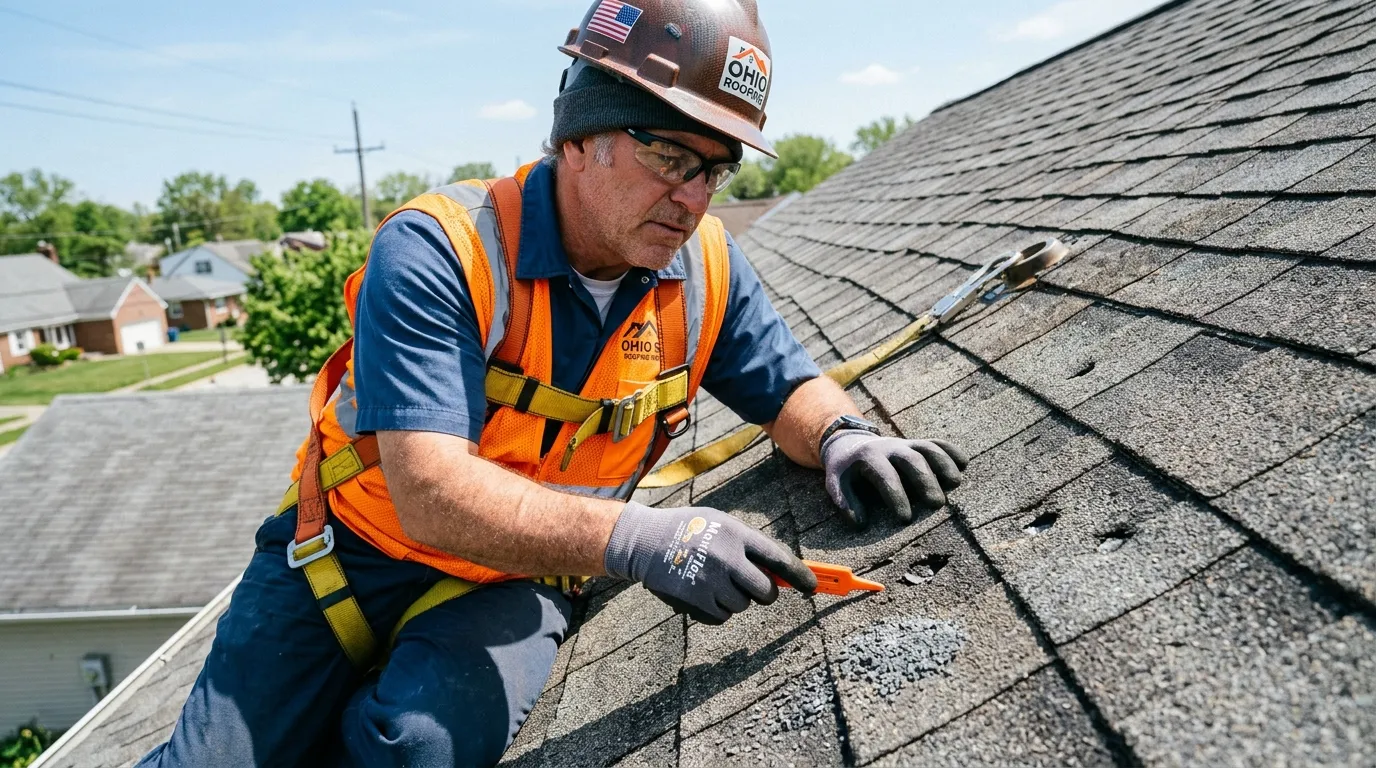
Spring and summer storms across Ohio can be deceptive. A severe weather front sweeps through Richland County, Canton, or the greater Cleveland area, leaving behind thunder, localized wind gusts, and sporadic hail. Once the sky clears, you look up from the driveway, see that all your shingles seem to be lying flat, and figure your home escaped without a scratch.
A few months later—often as winter freeze-thaw cycles set in—small, hidden issues begin making their presence known.
Severe weather affects roofing materials in subtle ways that are rarely obvious from fifty feet away on the ground. At the same time, seeing a fallen tree branch or a loose piece of trim does not automatically mean your entire roof system is compromised.
Here is a practical, level-headed guide to what homeowners can safely observe from ground level and inside the attic, how physical impact tends to behave on typical asphalt shingles, and why making definitive conclusions always requires a hands-on physical look by an experienced professional.
Safety First: Keep Your Ladders in the Garage
Before discussing visual markers, there is one non-negotiable principle every homeowner should follow after severe weather: do not climb onto your roof.
A roof that has just endured heavy wind, driving rain, or hail can have loosened shingles, wet granules that act like ball bearings underfoot, and compromised decking that may not bear weight safely. Emergency rooms across Ohio treat hundreds of ladder-fall injuries every storm season.
Everything a homeowner needs to observe for initial evaluation can be seen safely using three basic tools:
- A pair of binoculars.
- A dependable flashlight for the attic.
- Your smartphone camera to photograph ground-level findings with timestamps.
1. Ground-Level Collateral Clues (What Hail and Wind Leave Behind)
Hail rarely strikes a roof in isolation. If hailstones were large or dense enough to bruise roofing materials, they almost certainly left visible marks on softer surfaces around your property first.
Checking these “collateral indicators” gives you a clear sense of whether your property experienced direct impact:
GROUND-LEVEL COLLATERAL CHECKLIST
Small dings, dimples, or paint chips
Tears, stretches, or splintered frames
Dented aluminum heat-exchange coils
Chipped paint or hairline cracks
Heavy accumulation of loose mineral granules
Downspouts and Gutters
Aluminum and copper gutters are softer than asphalt shingles. Inspect your downspouts at eye level. Look for small circular dents, particularly on curved elbow joints where water exits. If the metal surfaces show distinct dimples, hailstones were dense enough to make physical indentations.
The Downspout Splash Block
Walk to the end of each downspout where runoff discharges onto splash blocks or grass. An unusually heavy pile of colored mineral granules indicates that turbulent water washed them off the roof surface. While a few loose granules are normal on newer roofs, a sudden, thick deposit following a storm suggests that hail or intense winds dislodged the protective coating from shingle surfaces.
Exterior Fixtures and Air Conditioning Units
Look at your outdoor condenser unit. The thin aluminum fins on the side bend easily under hail impact. Similarly, check mailbox lids, vinyl siding edges, plastic deck furniture, and painted wooden fences for fresh chips, scuffs, or splinters.
2. Binocular Roof Inspection: What Shingle Distress Looks Like
Standing back at the street or from various angles in your yard, use binoculars to scan the roof surface. You are looking for anomalies in the regular pattern of your roof.
Granule Loss and Darkened Dimples
When hail strikes an asphalt shingle, it creates a localized crushing force. It knocks away the surface granules and presses into the asphalt layer beneath. From the ground, this often appears as small, darker circular spots where the darker asphalt core is now exposed to open daylight. Over time, sunlight breaks down unprotected asphalt, potentially leading to micro-fissures.
Creased or Folded Shingle Tabs
Straight-line winds create strong uplift pressures along the edges and ridges of a roof. When wind gets under a shingle that has a weakened sealant strip, it can lift the tab upward.
- If the shingle bends backward and settles back down, it often leaves a distinct horizontal crease line across the top of the tab where the fiberglass mat cracked internally.
- Even if the shingle appears flat from the yard, that crease means the tab has lost its structural bond and can flap loose during subsequent storms.
Lifted or Displaced Metal Flashing
Check the critical transition zones:
- Around the base of brick chimneys.
- Inside valleys where two roof planes meet.
- Along rakes (the sloped edges of the gables) and eaves.
Wind gusts can pry up thin metal flashing strips or tear off ridge vent end-caps. If you notice flashing pulling away from brick mortar or crooked vent caps along the peak, water has an open pathway behind the main roofing surface.
3. The Attic Walkthrough: Checking for Moisture Indicators
If your ground observations suggest severe storm exposure, the next step is a dry, daytime check of your attic space. You do not need to walk on raw joists; simply standing near the attic access hatch with a bright flashlight can reveal important clues.
| Attic Checkpoint | What to Look For | Potential Significance |
|---|---|---|
| Roof Sheathing | Dark rings, water droplets, damp spots | Moisture migrating past outer layer |
| Daylight Gaps | Pinpoints of light along ridge/valleys | Displaced flashing or vent components |
| Attic Insulation | Matted, crusty, or clumping fiberglass | Past water accumulation from above |
| Rafter Framing | Streaks or discoloration on wood grain | Slow seeps along structural lumber |
- Look for Daylight: Turn off your flashlight for sixty seconds so your eyes adjust. If you see visible pinpoints of daylight around chimneys, plumbing vent pipes, or roof valleys, weather flashing may have shifted.
- Inspect the Underside of Decking: Point your light upward at the plywood or OSB boards. Dark circular stains, localized swelling, or damp insulation indicate that water has reached the subdeck.
- Smell for Trapped Humidity: An attic that smells noticeably musty or humid following a rainstorm often harbors moisture that has not yet dripped through bedroom drywall.
The Legal and Technical Reality: Why You Cannot Diagnose from the Ground
It is tempting to look at a few dents on a gutter and assume a full roof replacement is required. Conversely, it is easy to assume everything is fine because water hasn’t leaked into the living room ceiling.
Both assumptions are flawed, and Ohio consumer protection standards exist precisely to prevent premature conclusions:
Under Ohio Administrative Code (OAC 109:4-3-10):
Contractors and service providers are prohibited from making deceptive claims that repairs or replacements are mandatory when an actual hands-on structural inspection has not verified the condition.
A true assessment requires:
- Physically feeling shingle tabs to distinguish hail-induced fiberglass bruising from ordinary thermal blistering or natural aging.
- Checking the adhesion of manufacturer seal strips across multiple slopes.
- Examining chimney step flashing, counter-flashing, and rubber plumbing boots where caulking may have failed independently of storm action.
Frequently Asked Questions (Ohio Post-Storm Inspections)
What does genuine hail impact look like on asphalt shingles?
Hail impact typically leaves a round or oval indentation where granules have been dislodged, exposing the dark asphalt beneath. Unlike mechanical damage or foot traffic, hail marks usually feel slightly soft or spongy to the touch (similar to a bruised apple) because the fiberglass matting inside has suffered microscopic tears.
How quickly after an Ohio storm should a roof be evaluated?
If your neighborhood experienced severe wind gusts, fallen trees, or significant hail, scheduling an evaluation within a few weeks is a prudent approach. While small impacts rarely cause immediate ceiling leaks, waiting until winter can allow repeated freeze-thaw cycles to widen small fractures. Documenting conditions promptly also provides clear chronological context should you ever choose to consult an insurance professional.
Can a roof have wind damage without water dripping through the ceiling?
Yes. Modern roofs have multiple protective barriers, including asphalt shingles, synthetic underlayment, and ice-and-water shields. Strong winds can break shingle sealant bonds or lift flashing without immediately penetrating the underlayment. However, once the outer layer is compromised, wind-driven rain can slowly saturate the wood decking over months before showing visible stains inside living spaces.
Moving Forward Responsibly: The Value of an On-Site Evaluation
If your post-storm walkaround revealed dented gutters, displaced shingles, or damp attic framing, the most responsible next step is to schedule an objective, physical evaluation with an experienced local roofing tradesperson.
Avoid high-pressure door-to-door solicitors who arrive immediately after a storm with pre-printed contracts or promises of “guaranteed free roofs.” Reliable, reputable craftsmen who live and work in North Central Ohio do not rely on scare tactics. They conduct systematic inspections, photograph findings clearly, and provide honest, transparent assessments based solely on what the roof structure actually shows.
Editorial Notice & Legal Disclaimer
Important Consumer Notice: This article is published strictly for general informational, perspective, and editorial opinion purposes. It is not designed to provide structural engineering, professional roofing, insurance adjusting, legal, or building code advice, nor is it intended to educate, instruct, or influence any homeowner's repair, filing, or contracting decisions.
Visual observations discussed in this guide are non-definitive indicators and do not constitute a formal structural diagnosis or guarantee of storm-related loss. Home Services OH LLC does not conduct physical roof inspections, represent homeowners in insurance claims, perform contracting work, or promise claim approvals. Homeowners must independently engage qualified, registered, and insured local roofing professionals to conduct safe physical evaluations of their property.
Suspect Storm or Hail Impact on Your Property?
Don’t guess, and don’t risk climbing onto a potentially damaged roof. Connect with a trusted, independent local professional through Home Services OH.
👉 Request an In-Person Roof Evaluation Through Home Services OH
We connect Ohio homeowners with vetted, independent local contractors who provide honest physical evaluations with zero high-pressure sales.