
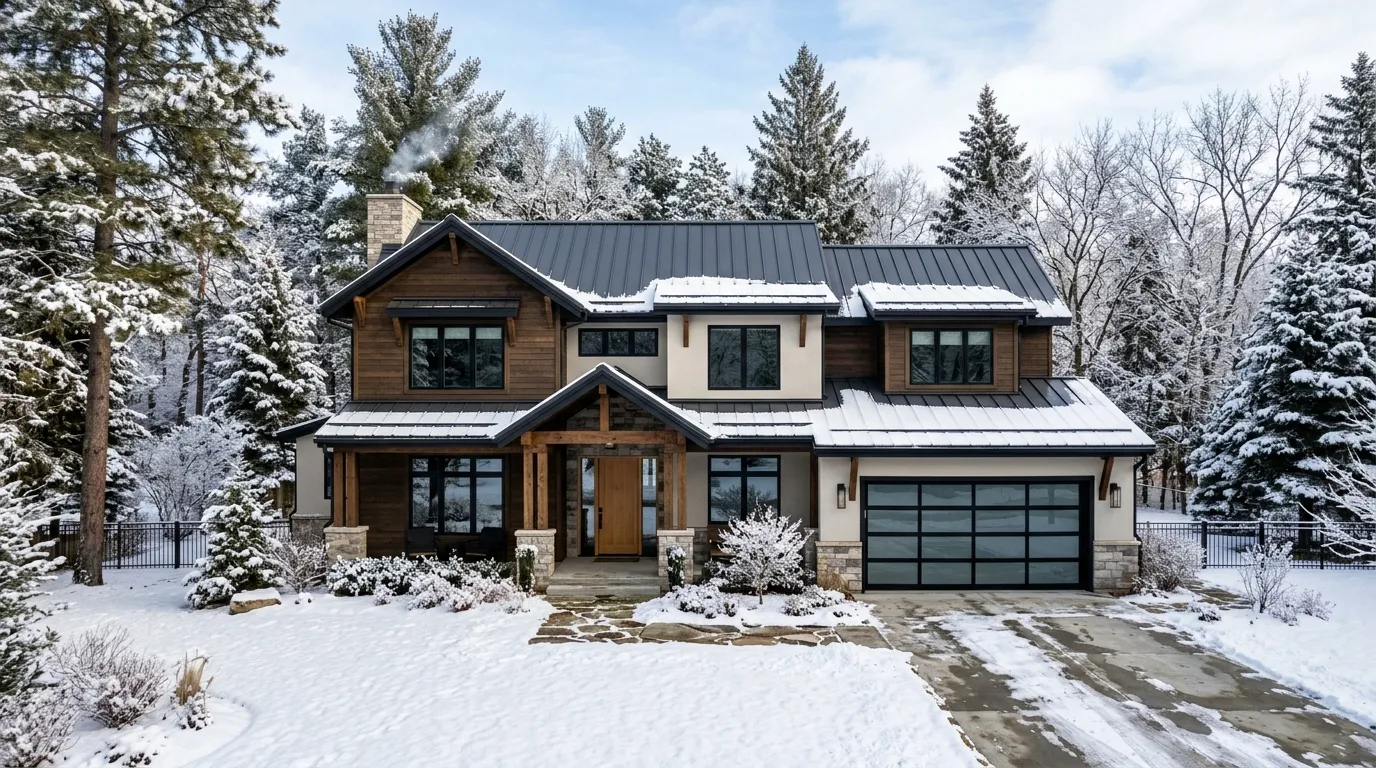
Anyone who has spent a winter between Lake Erie and the Ohio River knows the weather doesn’t follow a script. One week brings sub-zero wind chills and heavy lake-effect snow; four days later the thermometer jumps into the forties, turning that snowpack to slush before a hard freeze sets back in overnight.
That freeze-thaw rhythm is one of the harder tests a roof faces anywhere in the country.
When homeowners notice curling shingle edges, or just want to get ahead of the next cold front, the conversation usually comes down to two options: architectural asphalt shingles and standing seam metal.
Both have a long history across Ohio, from rural homesteads in Richland County to older suburbs outside Columbus, but they hold up to cold weather in different ways. Here’s how each one tends to perform once winter settles over the Buckeye State.
Ohio's freeze-thaw cycle
Winter is hard on Midwest roofs mostly because of moisture changing states over and over, not the cold air itself.
When snow sits on a roof deck, warm air escaping from the attic melts the underside of that snow layer. The water trickles down toward the eaves and gutters, areas that stay cold because they sit beyond the home’s heated envelope. Once that water reaches the cold overhang, it refreezes and slowly builds up what roofers call an ice dam.
Water backed up behind that ice looks for any seam or nail hole to slip through. Add in temperature swings of twenty or thirty degrees in a single day, and any weak point in the roofing material starts to show.
Architectural shingles
Architectural shingles, sometimes called dimensional or laminate shingles, have been the standard choice in Ohio neighborhoods for years. Unlike the flat three-tab shingles of decades past, they’re built from multiple laminated layers of fiberglass mat and asphalt coating, topped with mineral granules.
They’re a multi-layer asphalt-fiberglass composite, fastened with concealed nails under an adhesive strip, and their textured surface holds snow rather than shedding it right away.
How they handle winter
The textured surface creates enough friction that snow tends to melt off gradually instead of sliding all at once, which matters if there’s a walkway, driveway, or landscaping right below the roof edge. Modern asphalt formulations flex with normal temperature changes, but they stiffen in extreme cold, and older or weathered shingles can get brittle when high winds hit during a cold snap. The mineral granules protect against UV and impact, but hail and heavy sleet knock them loose over time, especially on an aging roof.
Where to pay attention
Shingle roofs rely on overlapping pieces held down by fasteners, so their winter performance depends a lot on what’s underneath: the ice-and-water barrier along eaves, valleys, and penetrations. Without a properly adhered membrane and balanced attic airflow, backed-up ice water can push past even well-installed shingle seams.
Standing seam metal roofing
Standing seam metal works on a different principle. Instead of hundreds of overlapping pieces, it uses continuous vertical panels that run from ridge to eave, interlocking at raised seams that hide the clips and fasteners underneath.
It’s built from coated steel or aluminum panels with concealed interlocking seams and hidden expansion clips, and its smooth surface sheds snow quickly once the sun or ambient heat warms it up.
How it handles winter
The painted metal surface offers little grip, so snow tends to release in large sheets once temperatures rise or sunlight warms the panels, which cuts down on the weight sitting on the roof trusses. Because the fasteners are concealed under the seams rather than exposed on the panel face, there’s nothing that can dry out or back out from repeated temperature swings. And with long vertical runs and raised seams, there are very few horizontal spots where backed-up meltwater could get in.
A few things to plan for
Because snow slides off metal so readily, homeowners often add snow guards or retention brackets above doors, garages, and HVAC units so it doesn’t come down unexpectedly. Metal panels block moisture from above, but they don’t replace the need for good attic insulation and airflow. Warm interior air can still condense on the cold underside of the decking if the attic isn’t ventilated properly, regardless of what’s on top.
Comparing the two, structurally
Every home has its own roof pitch, sun exposure, and character. Rather than generic scores, here’s how the two options tend to compare physically:
| Factor | Architectural shingles | Standing seam metal |
|---|---|---|
| Snow behavior | Holds snowpack, melts gradually | Sheds once warmed, may need snow guards |
| Seam design | Overlapping tabs with sealed strips | Continuous panels with raised, concealed seams |
| Thermal movement | Stiffens in sub-zero cold, flexes in warmth | Panels glide on clips to absorb expansion |
| Hail response | Granules absorb impact, heavy hail can bruise surface | Resists puncture, heavy hail may dent cosmetically |
| Fastener exposure | Hidden beneath overlapping layers | Fully concealed inside seams |
| Weight on decking | Moderate, standard for residential framing | Often lighter per square than asphalt |
| Look | Blends into traditional and historic subdivisions | Modern lines, suits farmhouse and rustic styles |
Frequently asked questions
Does snow really slide off a metal roof all at once in Ohio?
Often, yes. Metal panels absorb heat quickly in sunlight, and once a thin film of water forms between the panel and the snowpack, gravity takes over and large sections can release at once. That’s why installers often talk about snow guards over entryways, porches, and mechanical units.
Can you install metal roofing directly over old shingles in Ohio?
Some manufacturers and local codes allow it over a single layer of asphalt shingles, but most contractors recommend a full tear-off to the decking. That lets an inspector check for hidden moisture damage or rotted rafters before new panels go on, and local codes also limit how many layers are allowed.
Are metal roofs noticeably loud in sleet or hail?
Not usually, on a typical home with solid plywood decking, modern underlayment, and a properly insulated attic. That combination muffles sound about as well as any other roofing material.
Which material stops ice dams better?
Neither one, on its own. Ice dams form because heat escaping from the living space warms the roof deck unevenly. Standing seam metal has fewer horizontal joints for water to get through, but actually solving ice dams means fixing attic insulation, sealing air leaks, and balancing soffit-to-ridge ventilation.
Why an honest estimate needs someone on your roof
It’s tempting to search for a quick, universal quote online, but no responsible contractor can size up a real roof from behind a keyboard.
Every Ohio home brings its own mix of variables: how steep the roof planes are, which affects safety, waste, and labor; the condition of the sub-decking, which only shows up when someone checks for soft spots, sagging rafters, or hidden rot; the flashing around chimneys, sidewalls, dormers, and skylights; and how well the attic breathes between soffit and ridge.
Those things differ house to house, so the only reliable way to know what material fits yours, and what the job actually involves, is an on-site look.
Editorial Notice & Legal Disclaimer
This article shares a general, editorial perspective. It isn't structural engineering, roofing, legal, or building code advice, and it shouldn't be the basis for a purchasing or renovation decision on its own.
Every home is different. Local weather, deck condition, and municipal codes all vary from property to property. Home Services OH LLC doesn't inspect properties, perform repairs, or guarantee specific material lifespans or performance. Talk to an independent, licensed, and insured local tradesperson before starting any project.
Thinking about your roof before the cold sets in?
If your roof is showing wear, or you’d just like an experienced set of eyes on your flashing, decking, and ventilation, connect with a vetted local professional.
Request an in-person roofing evaluation through Home Services OH Connect directly with trusted, independent local specialists who know Ohio homes and building traditions.