
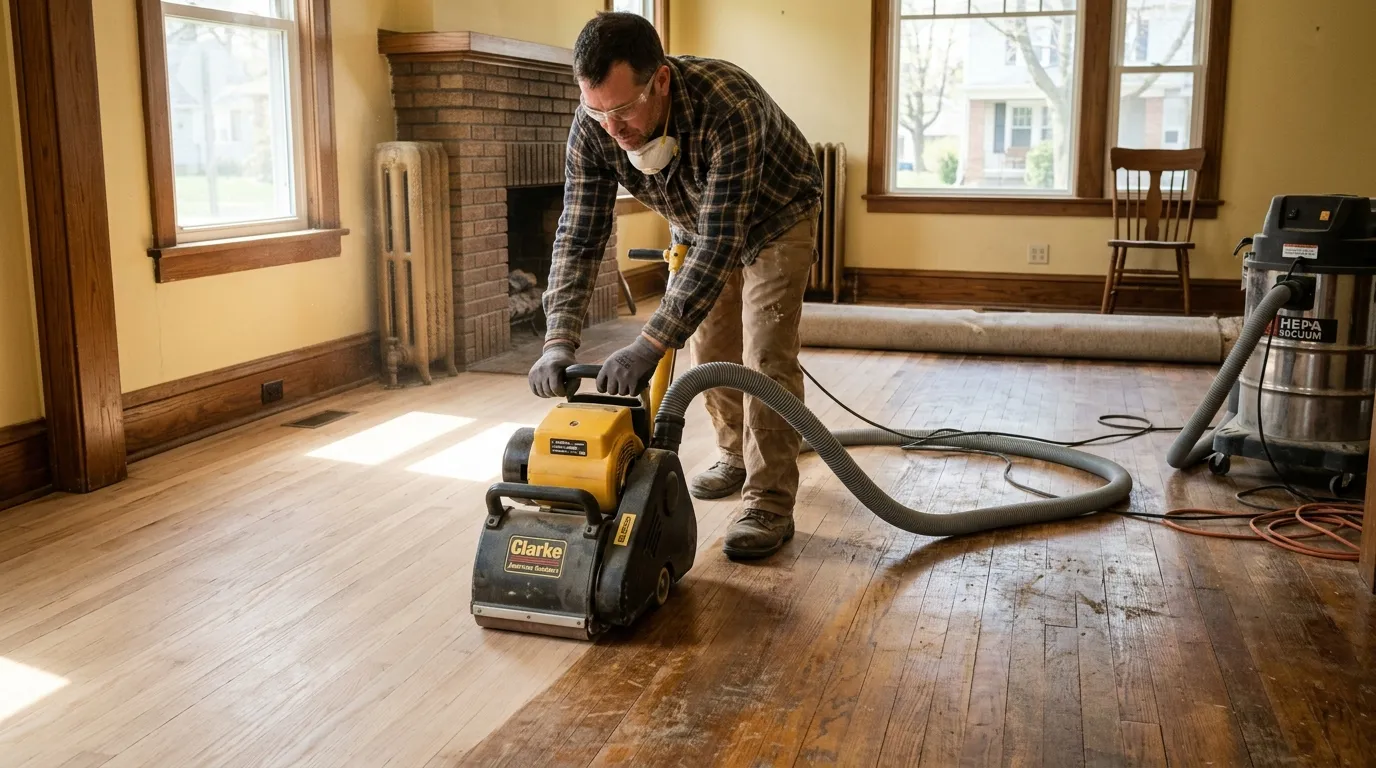
Tuck into almost any established neighborhood in Ohio—from the turn-of-the-century brick colonials of Ashland and Mansfield to the classic mid-century ranches of Columbus—and there is a high likelihood that beneath worn wall-to-wall carpeting lies a genuine architectural treasure: original 3/4-inch solid red or white oak hardwood floors.
Decades ago, regional builders installed real, solid timber milled from Appalachian forests. These floors were built with exceptional density and natural character, designed to be walked on by generations of families.
However, after sixty or eighty years of moving furniture, pet claws, active children, and occasional radiator or plant pot spills, vintage hardwood can look tired. You may see gray traffic paths in doorways, deep water rings near old radiators, or gaps between boards that open up during dry winter months.
When this happens, homeowners face a critical question: Can these original wood floors be restored through professional sanding and refinishing, or do the boards need to be torn out and replaced?
Here is a practical, craftsman’s guide to assessing your hardwood’s remaining wear layer, addressing deep stains, and understanding modern dust-containment restoration.
1. The Anatomy of a Solid Plank: Tongue, Groove, and the Wear Layer
To understand whether your floor can be sanded again, you have to look at how solid hardwood planks fit together:
ANATOMY OF A 3/4" SOLID TONGUE-AND-GROOVE PLANK
[ Wear Layer (Usable Wood for Sanding) ] ~ 1/4" to 5/16" Thick --------------------------------------- (Top Surface of Tongue) [ The Tongue Profile ] ====== ====== [ The Groove Channel ] --------------------------------------- (Bottom of Tongue) [ Structural Base Layer ] ~ 1/4" to 5/16" Thick [ Blind Nail Driven at 45-Degree Angle into Wood Subfloor ]
The “Wear Layer” Above the Tongue
A standard solid hardwood board is 3/4-inch thick. However, you cannot sand down all three-quarters of an inch.
The usable wood—known as the wear layer—is the wood that sits above the tongue and groove. When a floor is brand new, this layer is typically around 1/4 to 5/16 of an inch thick.
Each time a heavy commercial drum sander levels the floor, a tiny fraction of an inch of wood fiber is removed. If a vintage floor has already been sanded three or four times over the past century, that wear layer can become paper-thin. If a drum sander cuts down to the top of the tongue, the tongues will crack and split, exposing fastener heads and permanently ruining the boards.
2. The "Vent Register Test": How to Measure Remaining Wood
How can a homeowner check their floor’s remaining thickness without tearing up a board in the middle of the room?
THE DUCT REGISTER INSPECTION TRICK
Locate a floor heat register vent in the room.
Carefully lift the metal grate out of the duct boot.
Look at the exposed cross-section of the flooring boards where the carpenter cut the opening for the vent.
Measure the depth of solid wood above the horizontal tongue line with a small ruler or flashlight.
By examining the cross-section around the heating duct cut, you can clearly see:
- How thick the overall plank is.
- How much solid wood remains above the tongue-and-groove joint.
- Whether the boards are solid timber or engineered plywood veneers.
If you still have substantial wood thickness above the tongue, the floor is an excellent candidate for full sanding and refinishing. If the wood above the tongue is shaving-thin, a gentle “screen and recoat” (abrasive buffing without removing wood) or selective replacement may be the safer route.
3. Dark Stains: Surface Grime vs. Deep Tannin Penetration
One of the most common reasons homeowners consider replacing old hardwood is the presence of dark, unsightly stains.
| Stain Type | Root Chemical Cause | Restoration Strategy |
|---|---|---|
| Gray Traffic Wear | Surface finish worn away; bare wood absorbing ambient dirt and foot grime | Sands out cleanly during normal initial drum sander pass |
| Surface Paint Spills | Splatters from past room painting | Easily removed during initial cut |
| Black Pet Stains | Ammonia in pet accidents reacting with natural wood tannins | Deep penetration; may require selective board replacement |
| Black Water / Radiator | Iron in radiator water reacting with | Often deep into wood cells; |
| Stains | oak acid to form iron tannate | test spot or lace in new boards |
The Chemistry of Black Water Stains
Oak contains high levels of natural tannic acid. When water containing trace minerals or iron (such as water leaking from an old cast-iron radiator or rusty plant saucer) soaks into oak, a chemical reaction occurs, forming deep black iron tannate deep inside the wood cellular structure.
- Moderate Stains: Many surface stains sand out during the initial coarse-grit sanding cut.
- Deep Stains: If dark discoloration penetrates all the way through the board to the subfloor, no amount of sanding will eliminate it without creating an obvious dish or depression in the floor.
The Craftsman’s Solution: “Lacing In” Replacement Boards
You do not have to tear out an entire room of hardwood just because a two-foot section under an old window has black stains.
A skilled hardwood craftsman can perform what the trade calls lacing in (or board weaving):
- The damaged boards are carefully cut out along their length without disturbing adjacent wood.
- New raw oak boards matching the exact width, cut (plain-sawn vs. quarter-sawn), and species (red vs. white oak) are laced into the existing stagger pattern.
- The entire room is sanded together, taking on the same fresh stain and finish so the repair blends seamlessly into the surrounding floor.
4. Dust-Containment Sanding: No More Lingering Mess
Years ago, having hardwood floors refinished meant sealing every doorway with plastic sheeting, finding fine sawdust inside closed kitchen cabinets for months, and dealing with intense lingering odors.
Modern professional hardwood refinishing has advanced dramatically:
MODERN DUST-CONTAINMENT TECHNOLOGY
Powerful multi-stage HEPA vacuums connect directly to drum and edger sanders.
Dust is evacuated at the point of cutting before it can become airborne.
Protects air ducts, furnishings, and adjacent rooms from fine wood flour.
Modern dust-containment systems collect wood dust directly at the abrasive drum, pulling it through sealed hoses into multi-stage HEPA filtration units. This technology keeps interior air clean, prevents dust from settling into wet finish coats, and makes the refinishing process far more convenient for busy households.
5. Protective Sealers: Water-Based vs. Oil-Modified Polyurethane
Once the wood is sanded down to a silky, bare surface, applying the protective clear coat is what seals the wood from moisture and daily foot traffic.
| Protective Clear Coat | Visual Color Tone | Operational Attributes |
|---|---|---|
| Oil-Modified Poly | Rich, warm amber patina that deepens over years of sunlight | Classic look; longer dry time; traditional solvent odor during cure |
| Commercial Water-Based | Clear, non-yellowing; reveals | Fast drying; low odor/VOC; excellent |
| Polyurethane (2-Part) | true natural timber color | commercial-grade scuff resistance |
- Oil-Modified Polyurethane: The traditional Midwest favorite. It imparts a warm, golden-amber glow that enhances the grain of vintage oak, creating a warm, historic feel that matches classic Ohio home architecture.
- Modern Two-Component Water-Based Finish: Rapidly becoming the standard in modern remodeling. It dries crystal clear without yellowing, allowing natural wood tones to shine through. It cures exceptionally hard, produces minimal odor, and allows homeowners to walk in socks on the floor much sooner after application.
Frequently Asked Questions (Hardwood Refinishing)
How can a homeowner tell if hardwood has enough thickness for another sanding?
The most reliable non-invasive way is to remove a floor heat register grate and examine the exposed edge of the wood floor. Measure the thickness of solid wood remaining above the horizontal tongue. If there is ample wood above the tongue, full sanding is generally feasible; if the layer is worn thin, buffing and recoating or board replacement is advised.
Can deep pet stains be sanded out of vintage oak floors?
Surface stains usually sand out. However, if animal accidents were neglected, ammonia reacts with the natural tannic acid in oak, staining the wood fibers all the way through to the subfloor. In those situations, professional craftsmen selectively cut out the stained planks and weave in fresh matching boards before sanding the entire room.
What finish resists everyday foot traffic best in Ohio homes?
High-traffic family homes often benefit from commercial-grade, two-component water-based polyurethanes or heavy-duty oil-modified polyurethanes applied in multiple coats. Both options create a durable, scratch-resistant protective film when applied over properly sanded wood.
The Value of an On-Site Hardwood Evaluation
You cannot determine whether an eighty-year-old oak floor can be salvaged simply by looking at a smartphone picture.
It requires a seasoned local wood floor craftsman to:
- Inspect board thickness and past sanding grooves in high-traffic hallways.
- Test dark spots to distinguish surface discoloration from deep tannin decay.
- Check subfloor fastening for squeaks or seasonal seasonal board movement.
- Show you physical stain samples directly on your own sanded wood so you can choose the exact tone that complements your home’s trim and cabinetry.
Restoring original hardwood preserves the authentic heritage of your Ohio home while adding enduring warmth and character for decades to come.
Editorial Notice & Legal Disclaimer
Important Consumer Notice: This article is published strictly for general informational, perspective, and editorial opinion purposes. It is not designed to provide timber structural engineering, architectural, historical preservation, or legal advice, nor is it intended to educate, instruct, or influence any homeowner's remodeling or purchasing decisions.
Wood species density, moisture content, prior sanding history, and subfloor fastening methods vary substantially across properties. Visual discolorations, surface cupping, or board gaps may stem from localized plumbing events or seasonal humidity shifts rather than catastrophic structural rot. Home Services OH LLC does not inspect flooring, operate milling equipment, or warrant wood finishes directly. Homeowners should consult directly with an independent, licensed, and insured local hardwood flooring craftsman to physically inspect wood thickness and evaluate restoration viability.
Ready to Bring Your Original Hardwood Floors Back to Life?
Uncover the beauty hidden beneath your carpet or worn finish. Connect with trusted, independent local hardwood flooring craftsmen through Home Services OH.
👉 Request an In-Person Flooring Consultation
We connect Ohio homeowners with dedicated, independent local flooring artisans who treat vintage hardwood with the respect and skill it deserves.